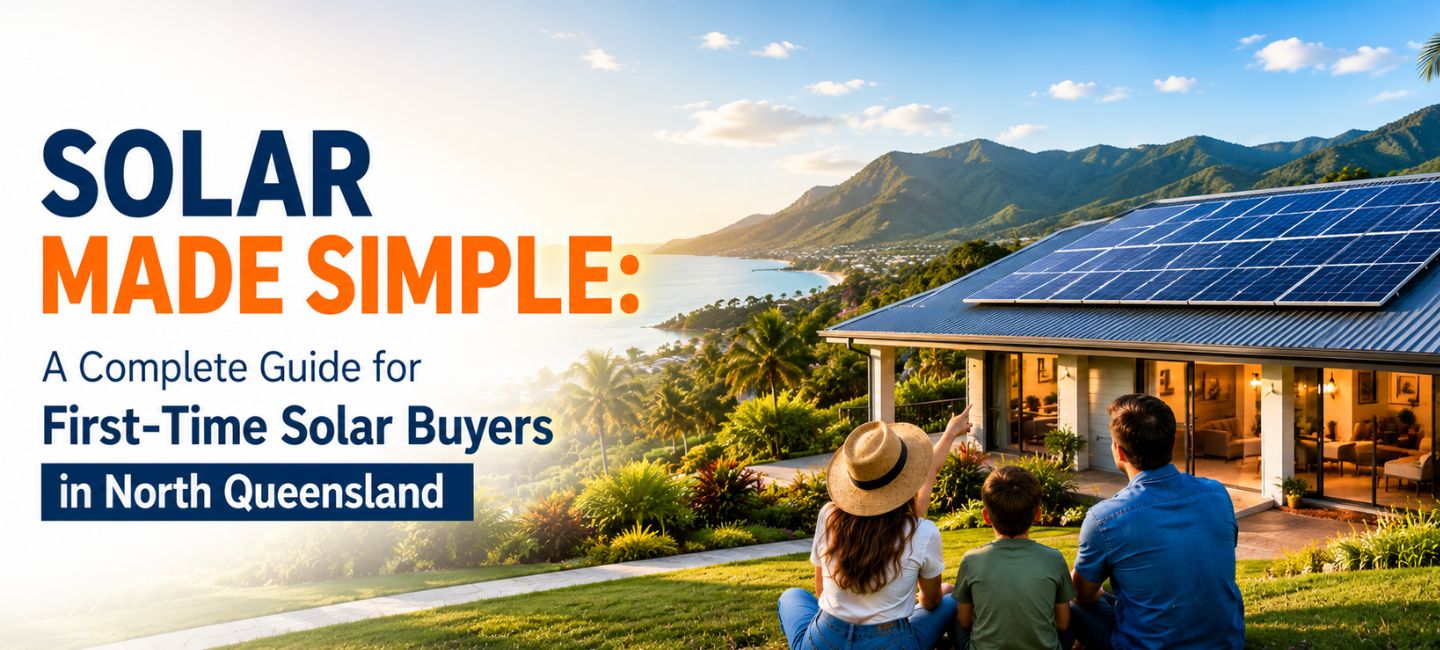
Solar Made Simple: A Complete Guide for First-Time Solar Buyers in North Queensland
Thinking About Solar in North Queensland? Start Here.
Solar power can look complicated when you first start researching it. You will quickly come across terms such as kW, kWh, inverter, feed-in tariff, battery storage, STCs and solar payback. Then there are dozens of panel brands, system sizes and installation options to compare.
The good news? You do not need to be a solar expert to make a smart decision.
This beginner-friendly guide explains how rooftop solar works, what makes solar different in North Queensland, how to choose the right system size, whether you need a battery, what incentives may be available, and the questions you should ask before signing a solar contract.
Whether you live in Cairns, Townsville, Port Douglas, Innisfail, Atherton, Mareeba or another part of North Queensland, this guide will help you take the first step with confidence.
Why Is Solar Such a Good Fit for North Queensland?
North Queensland is well known for its strong sunshine, warm climate and high cooling needs.
For many households, electricity consumption can rise because of:
- Air conditioning
- Pool pumps
- Refrigerators and freezers
- Hot-water systems
- Home offices
- Electric cooking
- Other high-energy appliances
That makes rooftop solar particularly interesting for homeowners who can use a large portion of their electricity during daylight hours.
Imagine a family in Cairns that regularly runs the air conditioner during the day. Without solar, much of the electricity powering that air conditioner may come directly from the grid.
With a correctly designed solar system, some of that daytime electricity can instead be generated directly from the home's rooftop.
The key idea is simple: generate electricity when the sun is shining and use as much of that electricity as possible in your home.
This is called solar self-consumption, and it is one of the most important concepts for a first-time solar buyer to understand.
What Exactly Is a Solar Power System?
A residential solar system generally consists of several important components.
1. Solar Panels
Solar panels, also called photovoltaic or PV panels, capture sunlight and convert it into electricity.
The more sunlight reaches the panels, the more electricity they can potentially generate.
However, panel performance is affected by factors such as:
- Roof orientation
- Roof pitch
- Shading
- Panel temperature
- Weather
- System design
- Panel quality
- Installation quality
So buying the panel with the highest advertised wattage does not automatically mean you will have the best solar system.
2. Solar Inverter
Solar panels produce DC electricity, while most household appliances use AC electricity.
The inverter converts the electricity generated by your solar panels into usable electricity for your home.
The inverter is one of the most important components of the system, so it should not be treated as an afterthought.
Australia has specific technical requirements for inverters. The Clean Energy Council maintains an approved products list, and current requirements should always be checked before installation.
3. Mounting System
Solar panels need to be securely attached to your roof using an appropriate mounting system.
A professional installer should consider:
- Roof type
- Roof condition
- Wind exposure
- Panel layout
- Waterproofing
- Structural considerations
- Local installation requirements
4. Electricity Meter and Grid Connection
If your home remains connected to the electricity grid, your solar system can interact with the grid.
When your panels produce more electricity than your home needs, surplus electricity may be exported to the grid, depending on your connection and electricity plan.
kW vs kWh: The Solar Terms Every Beginner Should Know
One of the easiest ways to get confused when buying solar is mixing up kW and kWh.
Here is the simple explanation:
kW = system power capacity
kWh = amount of energy produced or consumed over time
For example, a solar system might have a capacity of 6.6 kW.
Your household might then use 20 kWh of electricity per day.
Think of kW as the size of the tap and kWh as the amount of water that actually flows through it.
You do not need to calculate everything yourself. A good solar installer should provide a site-specific system design and estimated generation based on your property.
How Big Should Your Solar System Be?
This is one of the biggest questions first-time buyers ask:
“Should I buy a 6.6 kW, 10 kW or larger solar system?”
There is no universal answer.
The correct system size depends on your:
- Average electricity consumption
- Daytime electricity usage
- Roof space
- Roof orientation
- Shading
- Budget
- Future electricity needs
- Air-conditioning usage
- Pool equipment
- Electric vehicle plans
- Battery plans
- Grid connection requirements
A Simple Example
Suppose a household uses a lot of electricity during the daytime because someone works from home and the air conditioning regularly runs.
A larger solar system may allow the household to generate more of its own electricity.
On the other hand, a smaller household with lower electricity consumption may not need the same system size.
The cheapest system is not necessarily the best system.
Instead of asking:
“What is the cheapest solar system?”
ask:
“What solar system is the best match for my home and electricity usage?”
That small change in thinking can make a major difference.
Solar Panels in North Queensland: What Should You Look For?
Solar panels installed in North Queensland need to operate in a demanding environment.
When comparing panels, don't focus only on the headline wattage.
Look at:
Efficiency
Panel efficiency indicates how effectively a panel converts available sunlight into electricity.
Warranty
Review both:
- Product warranty
- Performance warranty
Also check who is responsible for supporting the warranty in Australia.
Temperature Performance
Solar panels can behave differently as temperatures increase. A professional system designer should account for local conditions rather than relying solely on laboratory specifications.
Durability
North Queensland properties may experience intense sunlight, heat, humidity, storms and strong weather conditions.
Depending on your location, environmental considerations such as corrosion resistance may also be relevant.
Approved Products
The Clean Energy Council maintains approved lists for solar PV modules, inverters and batteries that meet relevant Australian and international requirements.
Always verify the exact model—not simply the brand name—before purchasing.
Two houses can have identical electricity usage but require completely different solar designs. Why? Because their roofs may be different. Before recommending a system, an installer should consider: A beautiful-looking solar installation that performs poorly because of shading is not a good investment. What About North-Facing Roofs?Your Roof Matters More Than You Think
In Australia, north-facing panels have traditionally been attractive because they can receive strong sunlight throughout the day.
However, east- and west-facing panels can also be useful depending on household electricity consumption.
For example:
East-facing panels may generate more electricity earlier in the day.
West-facing panels may produce more later in the afternoon.
If your household uses significant electricity in the afternoon because of air conditioning, cooking or children returning home from school, a west-facing component could potentially be valuable.
System design should be based on your electricity usage—not a one-size-fits-all rule.
Do You Need a Solar Battery?
A battery stores excess electricity so it can potentially be used later.
For example:
Daytime:
Solar panels generate electricity → Home uses some → Battery stores some → Excess may be exported.
Night:
Solar panels stop generating → Home can potentially use stored battery energy → Grid electricity may be needed when the battery is insufficient.
This can be particularly interesting for households that consume a lot of electricity after sunset.
But a battery is not automatically necessary for every home.
A Battery May Make Sense If:
- You use a lot of electricity at night.
- Your daytime solar generation is much higher than your daytime consumption.
- You want greater energy independence.
- You want backup capability and your system is designed for it.
- Your electricity plan makes storage attractive.
- You want to increase solar self-consumption.
You May Want to Start With Solar Only If:
- Your electricity consumption is already concentrated during daylight.
- Your budget is limited.
- A battery does not currently make financial sense for your circumstances.
- You want to install solar first and consider storage later.
Solar first and battery later can be a valid strategy, provided the original system is designed with future expansion in mind.
What Is a Solar Feed-in Tariff?
A feed-in tariff (FiT) is the amount your electricity retailer pays for eligible solar electricity exported to the grid.
But there is an important point for first-time buyers:
Do not design your entire solar investment around the feed-in tariff.
Why?
Because the value of electricity you use yourself can be different from the value of electricity you export.
For example, if your solar electricity helps power your air conditioner while the sun is shining, you may avoid purchasing that electricity from the grid.
If you instead export the electricity, your retailer may pay you a feed-in tariff according to your electricity plan.
Queensland has different arrangements for South East Queensland and regional Queensland. Eligible customers outside SEQ may be able to access a regional solar feed-in tariff, subject to eligibility requirements and the relevant retailer/network arrangements.
The historic 44c/kWh Solar Bonus Scheme is not available to new customers; existing eligible customers can retain it until its stated expiry date, subject to maintaining eligibility.
The Better Question
Instead of asking:
“How much will I earn from exporting solar?”
also ask:
“How much of my solar electricity can I use myself?”
That is a much more useful question when comparing systems.
What About Solar Rebates and Government Incentives?
Solar incentives can change over time, so first-time buyers should always check official government information before signing a contract.
One important Australian mechanism is the Small-scale Renewable Energy Scheme (SRES), which can provide financial assistance through Small-scale Technology Certificates (STCs) for eligible systems.
Eligibility depends on factors including the system, location, installation and approved products.
The Clean Energy Council notes that approved products are required for STC eligibility, and its approved product lists can change over time.
What About Queensland Renters?
Queensland currently has a Supercharged Solar for Renters program.
The program opened in December 2025 and provides eligible landlords with rebates of up to $3,500 for installing solar on qualifying rental properties.
The rebate is tiered according to system capacity:
- 3 kW to under 4 kW: $2,500
- 4 kW to under 5 kW: $3,000
- 5 kW or more: $3,500
Eligibility requirements apply, and the landlord must obtain conditional approval before installing the system.
Because government programs can change, always verify current eligibility directly through the Queensland Government solar information before making a purchase.
How Much Does Solar Cost in North Queensland?
There is no single “correct” solar price.
A quote can vary according to:
- System size
- Panel brand and model
- Inverter
- Roof complexity
- Installation requirements
- Electrical work
- Switchboard upgrades
- Monitoring equipment
- Battery storage
- Warranty and after-sales service
- Location and travel requirements
That is why comparing two quotes based only on the final dollar amount can be misleading.
Compare the Complete Package
When reviewing quotes, compare:
System size + panel model + inverter model + estimated annual generation + warranty + installation + monitoring + after-sales support.
A slightly more expensive system may offer better value if it has stronger equipment, better design and more reliable support.
How Long Does Solar Take to Pay for Itself?
Solar payback depends on your individual circumstances.
A simple way to understand the concept is:
Solar payback period = Initial investment ÷ estimated annual financial benefit
But real-world calculations are more complicated.
Your annual benefit can be influenced by:
- Solar generation
- Electricity consumption
- Self-consumption
- Feed-in tariff
- Electricity prices
- System degradation
- Maintenance
- Financing costs
- Battery performance
- Future electricity usage
For this reason, be cautious about claims such as:
“Your solar system will pay for itself in exactly X years.”
Ask the installer to show you the assumptions behind the calculation.
The Biggest Mistake First-Time Buyers Make
Buying Based on Price Alone
A $5,000 system and a $9,000 system may look similar in a basic advertisement. But what exactly are you getting?
Ask:
- What panel model is being installed?
- What inverter model is being installed?
- How much electricity is the system expected to generate annually?
- What is the estimated self-consumption?
- What warranties are included?
- Who handles warranty claims?
- Is the installer appropriately accredited and licensed?
- Are the products currently approved?
- What happens if the roof requires additional work?
- What after-sales support is included?
The cheapest quote is not necessarily the lowest-cost option over the life of the system.
How to Choose a Solar Installer in North Queensland
Your installer is just as important as your equipment.
The Clean Energy Council administers the New Energy Tech Consumer Code (NETCC), which provides consumer protection standards for participating sellers. The program covers solar, batteries, EV chargers and other new energy technologies.
When comparing installers, look for:
Appropriate Accreditation
Ask who designed the system and who will install it.
Solar Accreditation Australia is now responsible for installer and designer accreditation in Australia.
Approved Products
Check the exact panel and inverter models against the relevant approved lists.
Clear Contract
Your contract should clearly explain:
- Total price
- Equipment
- Installation
- Warranty
- Payment terms
- Expected installation timeline
- Connection process
- Additional work
- Cancellation conditions
Local Knowledge
A North Queensland installer should understand local conditions and the practical requirements of installing solar in the region.
Multiple Quotes
The Queensland Government itself recommends obtaining multiple quotes for eligible solar programs rather than relying on a single supplier.
A Simple Solar Buying Checklist
Before signing anything, work through this checklist.
- Review your recent electricity bills.
- Calculate your average daily electricity consumption.
- Identify how much electricity you use during daylight hours.
- Check your roof condition.
- Look for shading.
- Decide whether you want battery storage now or later.
- Get at least two or three quotes.
- Compare exact panel models.
- Compare exact inverter models.
- Check approved product status.
- Check installer accreditation and licensing.
- Review product warranties.
- Review workmanship warranty.
- Ask for estimated annual solar generation.
- Ask for estimated self-consumption.
- Check your electricity retailer's feed-in tariff.
- Ask about grid connection.
- Read the contract carefully.
- Confirm what happens if additional electrical work is required.
- Avoid making a decision based only on the advertised price.
A Real-Life Example: Choosing Solar for a Cairns Family
Consider a fictional family of four living in Cairns.
They use electricity for:
- Air conditioning
- Refrigerator
- Washing machine
- Dishwasher
- Pool pump
- Television
- Computers
- Hot water
Their electricity usage is relatively high.
Instead of immediately purchasing the biggest solar system available, they first examine their electricity bills.
They discover that a significant amount of electricity is used during daylight hours.
Their installer then assesses:
- Roof space
- Roof orientation
- Shading
- Electricity consumption
- Potential future battery use
- Available system options
Rather than choosing the cheapest quote, the family compares several complete system proposals.
They then select a system that balances:
Generation + self-consumption + equipment quality + warranty + installation quality + future needs.
This is the right mindset for almost any first-time solar buyer.
Solar in North Queensland: What About Heat, Humidity and Storms?
North Queensland's environment deserves special attention.
High temperatures can affect solar equipment performance, while humidity, salt exposure in coastal areas and severe weather conditions can influence equipment selection and installation considerations.
This does not mean solar is unsuitable for North Queensland.
Quite the opposite.
It means system design and product selection matter.
If you live close to the coast, for example, ask your installer whether the chosen equipment is suitable for your environmental conditions.
Also ask about:
- Corrosion resistance
- Mounting hardware
- Roof fixings
- Weather exposure
- Equipment placement
- Warranty conditions
- Storm-related damage
- Insurance requirements
A professional installer should be able to explain these issues in straightforward language.
Should You Install Solar Before Buying an EV?
If you are planning to purchase an electric vehicle, tell your solar installer before the system is designed.
An EV can significantly increase household electricity consumption.
If you already know that an EV is part of your future plans, designing your solar system around your expected energy needs may be smarter than installing a system based only on today's consumption.
The same principle applies to:
- Electric hot water
- Pool heating
- Home extensions
- New air conditioners
- Induction cooking
- Home batteries
Think about the next 5-10 years-not just your current electricity bill.