
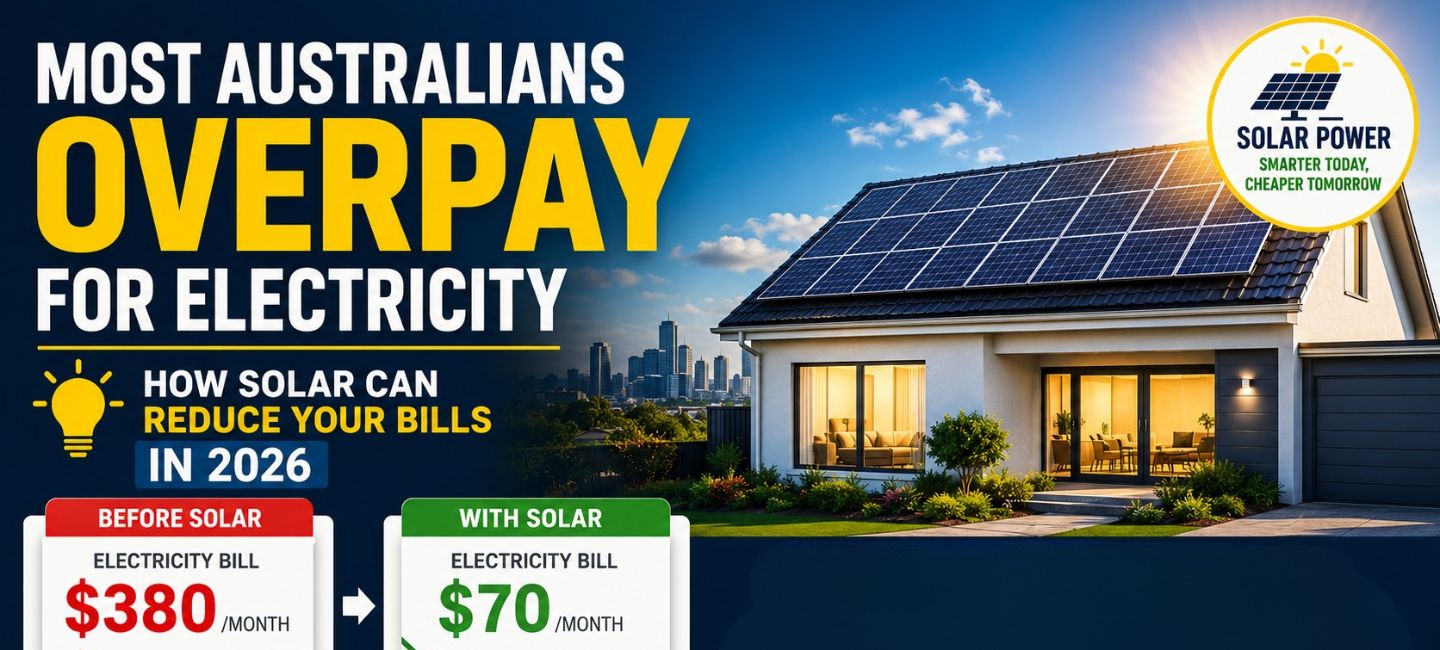
Electricity prices across Australia have increased significantly over the last few years, putting pressure on household budgets. While many families try switching providers or reducing appliance usage, the biggest opportunity to save often goes unnoticed—installing solar panels.
Today, thousands of Australian homeowners continue paying unnecessarily high electricity bills every month simply because they haven't made the switch to solar energy.
In this comprehensive guide, you'll discover:
- Why electricity costs continue to rise
- Why Australians unknowingly overpay
- How solar dramatically reduces power bills
- Common myths stopping homeowners
- How much money you could actually save
- Steps to choose the right solar system
- Whether 2026 is the perfect time to install solar
Whether you're a homeowner, investor, or business owner, this guide will help you make an informed financial decision.
Why Most Australians Are Paying Too Much for Electricity
Imagine receiving your electricity bill every quarter and wondering:
"How did it get this expensive?"
You're not alone. Millions of Australians ask this exact question every billing cycle.
The reality is simple:
Electricity prices have been increasing faster than many household incomes.
Several factors contribute to this:
- Rising wholesale electricity prices
- Increasing network infrastructure costs
- Inflation
- Extreme weather affecting energy demand
- Dependence on the traditional electricity grid
As a result, households relying solely on grid electricity often experience rising costs year after year.
Many families accept these higher bills as unavoidable—but they don't have to.
The Hidden Cost of Doing Nothing
Many homeowners believe delaying solar installation saves money. In reality, waiting often costs much more.
Let's consider an example.
Example
A family spends:
- $650 every quarter
That's approximately:
- $2,600 annually
If electricity prices continue increasing, that same family could spend:
- More than $30,000 over the next decade.
Now imagine reducing that bill by 50–80%.
That's the power of solar. Every month you delay switching means another month of paying more than necessary.
Why Electricity Bills Keep Rising
Several factors continue pushing prices upward.
1. Grid Infrastructure
Maintaining thousands of kilometres of electricity networks is expensive. Consumers ultimately pay these costs.
2. Peak Demand
During hot Australian summers, electricity demand increases dramatically. Higher demand often leads to higher prices.
3. Fuel Costs
Although Australia has abundant natural resources, fuel market fluctuations continue affecting electricity pricing.
4. Inflation
General economic inflation impacts:
- Labour
- Equipment
- Maintenance
- Energy generation
These costs are eventually passed on to households.
How Solar Changes Everything
Installing solar panels allows your home to generate electricity directly from sunlight.
Instead of buying most of your electricity from the grid, your rooftop begins producing free energy every day.
This means:
- Lower electricity bills
- Reduced dependence on energy retailers
- Protection against future price increases
- Cleaner renewable energy
How Solar Panels Save Money
Let's simplify the process.
During the Day
Your solar panels generate electricity. Your home immediately uses this electricity.
Instead of purchasing electricity from the grid, You use your own. This significantly reduces electricity costs. If your system produces more than your home uses:
The excess electricity can often be exported to the grid, where eligible customers may receive feed-in credits depending on their electricity retailer and state policies.
The Financial Benefits of Solar
Many homeowners focus only on lower power bills. However, solar offers multiple financial advantages.
Lower Electricity Bills
One of the biggest benefits.
Many households experience substantial reductions in electricity costs after installing a correctly sized solar system.
Protection Against Future Price Increases
Grid electricity prices may continue rising. Solar helps reduce your exposure to these increases.
Increased Property Appeal
Energy-efficient homes with solar are often more attractive to buyers because of their lower ongoing operating costs.
Long-Term Savings
While savings vary based on electricity usage, system size, location, and tariffs, a quality solar system can generate significant savings over its lifetime.
Common Reasons Australians Delay Installing Solar
Many homeowners wait because of misconceptions. Let's clear up some common myths.
Myth 1
Solar is too expensive.
Reality:
Installation costs have become much more accessible compared with a decade ago, and various government incentives may help reduce upfront costs depending on eligibility.
Myth 2
Solar only works in summer.
Reality:
Solar panels generate electricity year-round.
Production is generally higher on sunny days but panels still produce energy whenever there is daylight.
Myth 3
Solar needs constant maintenance.
Reality:
Quality solar systems generally require minimal maintenance beyond occasional cleaning and periodic inspections.
Myth 4
My roof isn't suitable.
Reality:
Many Australian homes can accommodate solar, though roof orientation, shading, and available space affect performance. A professional site assessment can determine suitability.
Signs You're Overpaying for Electricity
You may be spending more than necessary if:
- Your electricity bill keeps increasing.
- You rely entirely on grid power.
- Your home receives plenty of sunlight.
- You own your home.
- You use air conditioning regularly.
- You work from home.
- You have a growing family.
- You own electric appliances that run throughout the day.
If several of these apply to you, exploring solar could be worthwhile.
Is 2026 the Right Time to Install Solar?
For many Australians, the answer is yes.
Reasons include:
- Continued electricity price pressure
- Mature solar technology
- High-efficiency panels
- Improved inverter technology
- Government incentives in many regions
- Greater awareness of renewable energy
Waiting another year could mean paying additional money to your electricity retailer instead of investing in your own energy generation.
Choosing the Right Solar Installer
Not every installer delivers the same quality. Before making a decision, ask:
Are they licensed and accredited?
Choose installers who comply with Australian standards and hold appropriate industry accreditations.
Do they offer quality equipment?
Look for reputable solar panels and inverters backed by strong warranties.
Do they explain system sizing?
Every household is different. A quality installer recommends the right size rather than simply the biggest system.
Do they provide after-sales support?
Good customer service matters long after installation.
Simple Steps to Start Saving
If you're considering solar, follow these steps:
Step 1
Review your last 12 months of electricity bills.
Step 2
Estimate your average daily electricity usage.
Step 3
Request a professional solar assessment.
Step 4
Compare system sizes and equipment—not just price.
Step 5
Ask about warranties, installation quality, and expected system performance.
Step 6
Schedule installation with a trusted provider.
Frequently Asked Questions
Is solar worth it in Australia?
For many households with suitable roofs and daytime electricity use, solar can significantly reduce electricity costs over time.
Can solar completely eliminate my electricity bill?
Some homes may achieve very low bills under favourable conditions, but outcomes depend on energy usage, system size, weather, and tariff arrangements.
How long do solar panels last?
Many quality solar panels are designed to operate for 25 years or more, with gradual performance decline over time.
Do I need a battery?
Not always. A battery can increase the use of your own solar energy after sunset, but whether it's worthwhile depends on your energy usage patterns and budget.
Real Story
Imagine two neighbours.
Neighbour A
Continues paying increasing electricity bills every year.
Neighbour B
Installs a quality solar system. Every sunny day, their roof produces electricity. Instead of worrying about the next bill, they're generating much of their own energy. After several years, the difference in total electricity spending can be substantial. The biggest difference?
One made a decision. The other kept waiting.
Key Takeaways
✔ Electricity prices continue to put pressure on Australian households.
✔ Many homeowners overpay simply because they rely entirely on the grid.
✔ Solar can significantly reduce electricity costs when correctly designed and installed.
✔ Modern solar systems are reliable, efficient, and built for long-term performance.
✔ Choosing an experienced installer and quality equipment is just as important as selecting the right system size.
Conclusion
Every month you continue relying solely on grid electricity is another month of paying for energy you could potentially generate yourself.
Solar is no longer just an environmentally friendly choice—it has become a practical financial decision for many Australian households.
Whether your goal is reducing electricity bills, improving energy independence, or adding long-term value to your home, investing in a quality solar system could be one of the smartest decisions you make in 2026.
The earlier you start generating your own electricity, the sooner you may begin seeing the benefits.