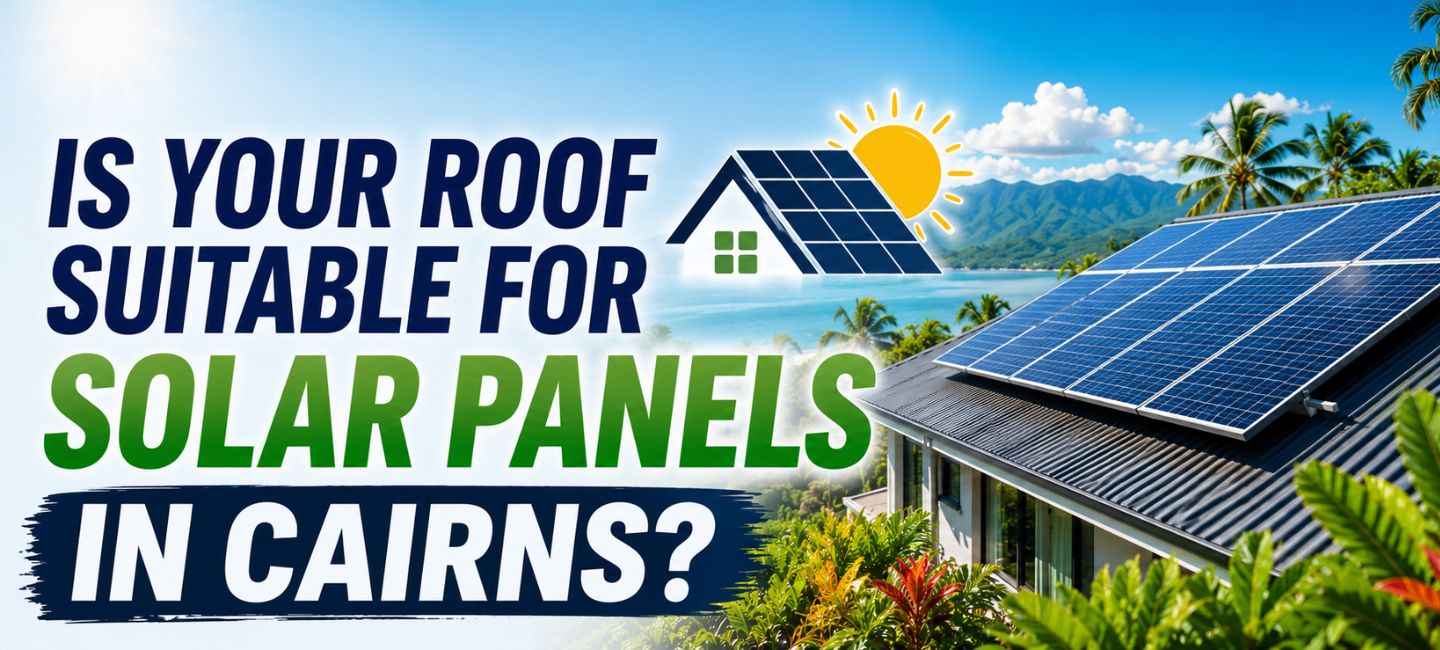
Is Your Roof Suitable for Solar Panels in Cairns? 10 Things You Should Check Before Installing Solar
Thinking about solar panels in Cairns? Your roof could be the most important part of the decision.
Cairns is an excellent location to consider rooftop solar. But before you start comparing solar panels, inverter brands or system sizes, there is one question you should answer first:
Is your roof actually suitable for solar panels?
A roof may look perfectly fine from the ground and still have issues that matter when installing a solar system. Its age, condition, shape, orientation, shading, structural strength and exposure to extreme weather can all affect whether solar panels are a good option.
This is particularly important in Cairns and Far North Queensland, where homeowners need to consider strong winds, tropical weather, heavy rainfall, heat and cyclone conditions alongside the usual solar considerations.
The good news is that having an older, unusual or less-than-perfect roof does not automatically mean you cannot install solar panels. In many cases, a professional installer can identify a suitable section of the roof or recommend the right mounting approach.
So, how do you know whether your roof is solar-ready?
Let's take a closer look.
Why Cairns Is a Great Place to Consider Rooftop Solar
Before discussing the roof itself, it is worth understanding why solar power makes sense for many Cairns homeowners.
Cairns receives significant solar exposure throughout the year. Bureau of Meteorology climate data for Cairns Aero shows an annual mean solar exposure of around 18 MJ/m² per day, although solar exposure varies substantially between seasons.
That means your roof has access to a valuable natural resource: sunlight.
A well-designed solar system can help a household:
- Generate electricity from sunlight
- Reduce reliance on grid electricity
- Potentially lower electricity bills
- Increase daytime energy self-sufficiency
- Make better use of available roof space
- Pair solar with battery storage in the future
However, more sunlight does not automatically mean every roof is suitable for solar panels.
The roof needs to provide a safe, secure and practical location for the system.
Queensland Government guidance also recommends researching the installation process, choosing an appropriately accredited installer and understanding system design, grid connection and ongoing maintenance before purchasing solar.
1. Start With the Age and Condition of Your Roof
One of the first questions a solar installer should ask is:
How old is your roof?
Solar panels are a long-term investment. If your roof is already showing signs of deterioration, installing panels before addressing those problems could create unnecessary complications later.
Imagine this situation.
Sarah owns a house in Cairns with a roof that is more than 20 years old. She wants solar because her household uses a lot of electricity during the day.
The roof looks acceptable from the driveway.
However, during the inspection, the installer discovers deteriorated roofing materials and areas that need attention.
Installing solar immediately might not be the smartest choice.
Why?
Because removing and reinstalling solar panels later to carry out major roof work can add unnecessary expense and inconvenience.
Look for signs such as:
- Cracked or damaged roofing materials
- Rust or corrosion
- Loose roof sheets
- Broken tiles
- Sagging areas
- Water leaks
- Deteriorated flashing
- Previous storm or cyclone damage
- Signs of moisture inside the roof
- Damaged gutters or roof structures
The rule is simple: repair significant roof problems before installing a long-term solar system.
A professional roof and solar assessment can help determine whether repairs are required before installation.
2. What Type of Roof Do You Have?
The good news is that solar panels can be installed on many common residential roof types.
Your roof might be:
- Metal
- Colorbond-style steel
- Concrete tile
- Terracotta tile
- Corrugated metal
- Flat or low-pitched
- Steeply pitched
The roof material itself does not automatically determine whether solar is possible.
Instead, installers need to consider how the panels can be safely mounted to the roof structure.
For example, metal roofing can often provide a straightforward mounting surface, while tiled roofs require appropriate mounting hardware and careful work around individual tiles.
Flat roofs may require a different mounting configuration to achieve a useful panel angle.
Why does this matter?
Solar panels need to remain securely attached to the building.
The mounting system must be appropriate for the roof type and the environmental conditions at the property.
This becomes especially important in Cairns because the solar system needs to be designed and installed with local weather conditions in mind.
3. Your Roof Must Be Strong Enough
Solar panels are not simply placed on top of your roof.
They are attached using a mounting system that transfers loads into the roof structure.
Therefore, an installer needs to consider whether the roof and supporting structure are suitable for the proposed installation.
Potential concerns may include:
- Older roofing structures
- Deteriorated timber
- Previous storm damage
- Structural modifications
- Weak or damaged roof sections
- Unusual roof construction
- Existing rooftop equipment
- Areas where mounting points may be difficult to access
This is one reason a professional assessment is more valuable than simply looking at your roof from ground level.
A solar panel system should be designed around your actual property — not based on a generic installation template.
4. Cyclone and Wind Conditions Matter in Cairns
This is one of the most important considerations for anyone searching for solar panels in Cairns.
Cairns is in a region where cyclone and high-wind conditions need to be taken seriously.
Queensland guidance on cyclone resilience explains that Wind Region C locations can have different wind classifications depending on factors such as exposure, terrain, hills and proximity to open areas or large bodies of water. The guidance describes classifications from C1 through C4, with higher classifications applying to more exposed locations.
In simple terms:
Not every property experiences wind in exactly the same way.
A home on relatively sheltered terrain may have different design requirements from a home in a highly exposed location.
This is why Cairns solar installation should not be treated exactly like installation in every other Australian city.
The installer should consider:
- Local wind conditions
- Roof shape
- Building characteristics
- Panel layout
- Mounting method
- Fixing locations
- Roof structure
- Exposure of the property
The goal is to create a system that is appropriately designed and securely installed for the property.
Don't make this mistake
Avoid choosing an installer based only on the cheapest quote.
A low upfront price is not necessarily a good deal if the installation has not properly considered the property's environmental and structural requirements.
5. Does Your Roof Get Enough Sunlight?
A roof can be structurally excellent and still be a poor location for solar panels if it receives too much shade.
Solar panels perform best when they have good access to sunlight.
Before installing solar, check whether your roof is affected by:
- Large trees
- Nearby buildings
- Tall palms
- Chimneys
- Roof structures
- Water tanks
- Antennas
- Other solar panels
- Nearby hills or structures
Remember that shadows can change throughout the day.
A roof that looks sunny at 9 AM may be shaded at 3 PM.
Think about the whole day
A good solar assessment should consider how sunlight reaches the proposed panel location throughout the day and across different times of the year.
This can help determine:
- Which roof section is best
- How many panels can realistically be installed
- Whether some sections should be avoided
- Whether shading could affect system performance
- Whether a different system design would be more appropriate
6. Roof Direction and Panel Orientation Matter
Another important consideration is roof orientation.
The ideal panel arrangement depends on the property, electricity consumption pattern, available roof space and system design.
In Australia, installers commonly consider north-facing roof areas, but that does not mean a house with an east- or west-facing roof cannot have an effective solar system.
In fact, an east-facing array may produce useful electricity earlier in the day, while a west-facing array may produce more during the afternoon.
That can be particularly relevant for households whose electricity consumption is higher later in the day.
Don't focus only on direction
A common mistake is asking:
"Is my roof facing north?"
A better question is:
"Which combination of roof areas will produce the best result for my household?"
Your electricity usage, shading, roof area, panel technology and system design all matter.
7. Do You Have Enough Roof Space?
You don't necessarily need a huge roof to install solar.
However, you do need enough suitable, unobstructed space for the number of panels required by your chosen system.
Roof space may be limited by:
- Skylights
- Chimneys
- Roof vents
- Air-conditioning equipment
- Satellite dishes
- Plumbing equipment
- Dormer windows
- Trees
- Multiple roof levels
- Shaded sections
A professional installer can assess the usable roof area and determine how many panels can realistically fit.
Bigger isn't always better
Some homeowners assume that installing the maximum number of panels is automatically the best option.
Not necessarily.
The right system should reflect your:
- Electricity consumption
- Available roof area
- Budget
- Future energy needs
- Potential battery plans
- Daytime electricity usage
A properly designed system can be more valuable than simply filling every available section of the roof.
8. What About Rain, Heat and Tropical Weather?
Cairns presents a unique environment for rooftop equipment.
The region experiences tropical weather, high humidity and substantial rainfall.
Bureau of Meteorology observations show that Cairns experiences significant seasonal variation in weather conditions, with rainfall and solar exposure changing throughout the year.
This makes installation quality particularly important.
Your solar system includes more than the panels themselves.
It can include:
- Solar panels
- Mounting rails
- Roof fixings
- Inverter
- Cabling
- Electrical protection equipment
- Monitoring equipment
- Potential battery storage
Each component needs to be suitable for the installation environment and installed correctly.
The system should also be designed to minimise unnecessary risks to the roof, including water ingress caused by poor workmanship.
Good solar installation isn't just about generating electricity — it is also about protecting the building underneath it.
9. Check Your Roof Before You Get Solar Quotes
Want to know whether your roof might be solar-ready?
Use this simple checklist before speaking with installers.
Solar Roof Suitability Checklist
Roof condition
- No major leaks
- No significant corrosion
- No broken tiles or damaged sheets
- No obvious structural damage
- No major storm damage
Roof space
- Enough unobstructed space
- Minimal shading
- Suitable roof sections available
- No major obstacles preventing panel placement
Solar performance
- Good sunlight exposure
- Suitable panel orientation
- Electricity usage matches proposed system
- Future energy requirements considered
Installation
- Mounting method suitable for the roof
- Roof structure assessed
- Local weather and wind conditions considered
- Installer appropriately accredited
- Product compliance checked
If you tick most of these boxes, your roof may be a good candidate for solar.
But remember:
This checklist is not a substitute for a professional site assessment.
10. Choose a Qualified Solar Installer in Cairns
Once you know your roof needs to be assessed, the next step is finding the right installer.
Queensland Government guidance states that solar installers must be accredited by Solar Accreditation Australia (SAA), and it recommends checking installer accreditation before proceeding.
You should also ask potential installers:
- Is my roof suitable for the proposed solar system?
- How will you assess the roof structure?
- How will the system be designed for Cairns weather conditions?
- What mounting system will you use?
- Which solar panels and inverter will you install?
- Are the products approved for use in Australia?
- What warranties are included?
- What happens if my roof requires repairs later?
- How will shading affect the system?
- What system size do you recommend and why?
The Clean Energy Council maintains information about approved solar PV modules, inverters and batteries that meet relevant standards and requirements for the Australian market.
Don't be afraid to ask questions.
A trustworthy solar professional should be able to explain the recommendation in plain language.
What If Your Roof Isn't Suitable for Solar Panels?
Don't assume that an unsuitable roof means you have to give up on solar.
There may be several options.
Option 1: Repair the roof first
If the roof is generally suitable but has damage, completing repairs before installation may solve the problem.
Option 2: Use another roof section
A different section of the roof may have better structural integrity, sunlight exposure or usable space.
Option 3: Consider a different mounting configuration
Depending on the property, an alternative mounting approach may be possible.
Option 4: Review the system size
You may not need as many panels as you originally expected.
Option 5: Explore other installation options
In some properties, ground-mounted or other solar configurations may be worth investigating, subject to space, planning and installation requirements.
The key takeaway is:
Don't decide that solar isn't possible until a qualified professional has assessed your property.
A Simple 5-Step Process for Cairns Homeowners
If you're ready to investigate solar, here's a straightforward approach.
Step 1: Inspect your roof
Look for obvious signs of damage, leaks, corrosion or deterioration.
Step 2: Identify shading
Check whether trees, buildings or other structures shade the roof during different parts of the day.
Step 3: Review your electricity usage
Look at your recent electricity bills and identify when your household uses the most electricity.
Step 4: Get professional solar assessments
Speak with reputable solar installers and ask them to assess your roof, sunlight exposure and energy requirements.
Step 5: Compare the complete proposal
Don't compare quotes based only on the headline price.
Look at:
- System size
- Panel specifications
- Inverter
- Mounting system
- Installation quality
- Warranty
- Monitoring
- Expected energy production
- After-sales service
- Installer accreditation
The cheapest solar quote isn't necessarily the best-value solar system.
Frequently Asked Questions About Solar Panels in Cairns
Can solar panels be installed on an old roof?
Possibly. The age of the roof does not automatically make it unsuitable, but its condition and structural integrity should be assessed before installation.
Are solar panels suitable for Cairns' cyclone conditions?
Solar can be installed in cyclone-prone areas, but the system needs to be appropriately designed and installed for the property's local conditions. Wind exposure, roof construction, mounting and fixing methods are important considerations. Queensland cyclone-resilience guidance highlights how site exposure can affect wind classifications.
Does my roof have to face north?
No. Roof orientation is one factor in solar design, but east-, west- and other orientations can potentially be useful depending on your home, shading and electricity consumption.
Can solar panels be installed on a metal roof?
In many cases, yes. Metal roofs are commonly used for solar installations, provided the roof and mounting method are suitable.
Can solar panels be installed on a tiled roof?
Yes, tiled roofs can often accommodate solar panels when the appropriate mounting hardware and installation techniques are used.
What if trees shade my roof?
Shading can reduce solar generation. An installer should assess how much shade reaches the proposed panel locations and consider the best system design.
Should I repair my roof before installing solar?
If the roof has significant damage or is approaching the end of its useful life, repairing or replacing it before installing solar may make more sense than installing panels and dealing with major roof work later.
How do I find a reliable solar installer in Queensland?
Start by checking installer accreditation and asking detailed questions about roof suitability, system design, products, warranties and installation methods. Queensland Government guidance recommends using appropriately accredited solar installers.
The Bottom Line: Is Your Cairns Roof Solar-Ready?
So, is your roof suitable for solar panels in Cairns?
It depends.
A suitable roof generally needs to provide:
- Good structural condition
- Adequate usable space
- Suitable sunlight exposure
- Appropriate mounting options
- Minimal problematic shading
- A design that accounts for local environmental conditions
Cairns offers strong potential for rooftop solar, but choosing the right system starts with the roof beneath it.
Don't simply look at your roof and decide whether solar will work.
Instead, get it professionally assessed.
The right installer can evaluate your roof condition, available space, orientation, shading, structural considerations and local installation requirements before recommending a system.
And that assessment could save you from an expensive mistake.
Ready to Find Out If Your Roof Is Solar-Ready?
Don't guess. Get your roof assessed before investing in solar panels.
If you're considering solar installation in Cairns, speak with a qualified local installer and ask for a property-specific assessment.
Your next steps:
- Check your roof condition.
- Review your electricity bills.
- Identify shading and available roof space.
- Request a professional solar assessment.
- Compare system design, quality, warranty and installation — not just price.
Your roof could be more than protection from the tropical weather — it could become one of your home's biggest energy assets.
What do you think?
Is your Cairns home ready for solar panels, or does your roof need some work first?
Leave a comment or contact a qualified solar professional to arrange an assessment.