A Step-By-Step, Beginner-Friendly Blueprint to Finding the Perfect Solar System Size - No Technical Knowledge Needed
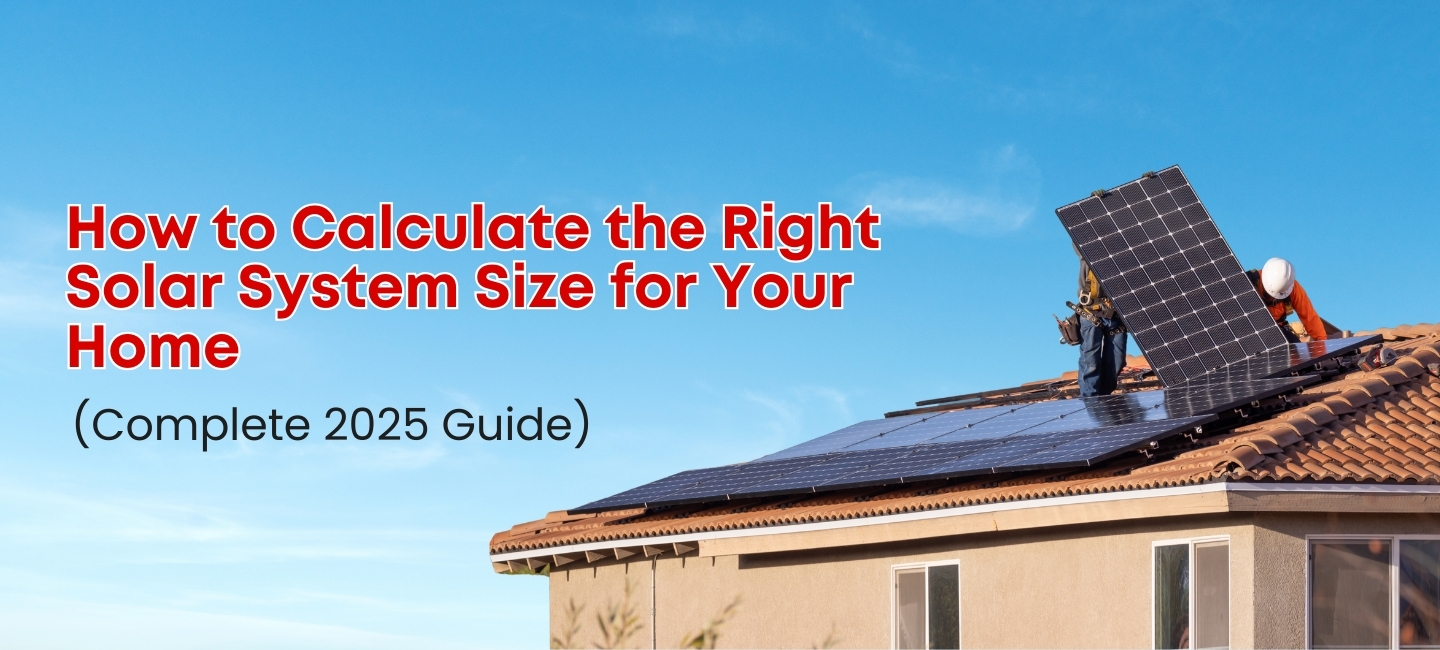
How to Calculate the Right Solar System Size for Your Home
1. Understand Your Electricity Consumption: The Foundation of Solar Sizing
Before choosing any solar system, you must understand how much electricity your home consumes - because your solar system must compensate for that usage.
Step 1: Look at Your Electricity Bill
Your bill will usually show your usage in kWh (kilowatt-hours).
Look for:
- Monthly consumption in kWh
- Daily average consumption
- Peak usage months
If your bill doesn’t show daily consumption, use this formula:
Daily Consumption (kWh/day) = Total Monthly kWh ÷ Number of Days in Bill Cycle
Real-Life Example
If your monthly consumption is 750 kWh, and the billing period is 30 days:
750 ÷ 30 = 25 kWh per day
This 25 kWh/day becomes your baseline.
2. Learn the Basic Solar Sizing Formula (Super Simple!)
Once you know your daily consumption, use this formula:
Solar System Size (kW) = Daily Energy Usage (kWh/day) ÷ Average Sunlight Hours
Sunlight hours = the number of peak sun hours in your region (usually 4–6 in most places).
Example Calculation
If:
- You use 25 kWh/day
- Your area receives 5 hours of peak sunlight per day
Then:
25 ÷ 5 = 5 kW
You need a 5 kW solar system.
3. Identify Peak Sun Hours in Your Location
Peak sun hours are NOT the same as total daylight hours.
They represent the intensity of sunlight — i.e., how many hours per day the sun provides enough energy for panels to perform at full capacity.
Common Peak Sun Hour Estimates
- Australia: 4.5 – 6.5 hours
- India: 4 – 6 hours
- USA: 3 – 5.5 hours
- UK: 2 – 4 hours
Tip
A solar installer can calculate this precisely, but using average values works well for home calculations.
4. Factor in Your Energy Offset Goals
Ask yourself:
Do you want to:
- Offset 50% of your bill?
- Offset 75% of your bill?
- Become 100% energy independent?
Example
If your required system size is 5 kW, but you want:
- 50% offset → 2.5 kW
- 75% offset → 3.75 kW
- 100% offset → 5 kW
5. Include System Losses & Real-World Efficiency Factors
Even the best systems lose 10–20% efficiency due to:
- Heat
- Dust
- Shading
- Cable losses
- Inverter inefficiency
- Weather fluctuations
Add 20% to Your System Size
To compensate for real-world losses, simply add 1.2 to your result:
Adjusted Solar Size (kW) = Solar Size × 1.2
Example
5 kW × 1.2 = 6 kW actual recommended system size.
6. Understand Panel Wattage & How Many Panels You Need
SEO Keywords: how many solar panels needed, panel wattage calculation, solar panels per kW
Secondary: rooftop solar layout, panel efficiency
Panel wattage typically ranges from 350W to 600W in 2025.
Formula to Calculate Number of Panels
Number of Panels = System Size (W) ÷ Panel Wattage
Example
If you need a 6 kW system (6000W) and use 500W panels:
6000 ÷ 500 = 12 panels
7. Measure Your Roof Space (Very Important!)
SEO Keywords: roof size for solar, rooftop area calculation
Secondary Keywords: panel spacing, roof suitability, installation planning
A typical solar panel needs 1.7 sq. meters of space.
Roof Space Formula
Required Area = Number of Panels × 1.7 sqm
Example
If you need 12 panels:
12 × 1.7 = 20.4 sq. meters
Additional Considerations
- Avoid shaded areas
- Maintain space for maintenance
- Check roof angle
- Consider mounting structure type
8. Considering Battery? It Changes the Calculation
SEO Keywords: solar system with battery, battery-compatible solar size
Secondary: hybrid inverter sizing, solar + storage calculation
If you plan to install a solar battery, your required system size increases.
Why?
Because the system must:
- Power your home
- Charge the battery
- Keep reserve power for night usage
Rule of Thumb
Add 25–40% extra capacity for homes with batteries.
Example
6 kW system + 30% extra = 7.8 kW solar system
9. A Complete Step-By-Step Example (End-to-End)
Let’s calculate for a realistic home scenario.
Home Data:
- Monthly usage: 900 kWh
- Location: India (5 sun hours)
- Wants 100% offset
- Battery planned
- Panel wattage: 550W
Step 1: Daily Consumption
900 ÷ 30 = 30 kWh/day
Step 2: Base Solar Size
30 ÷ 5 = 6 kW
Step 3: Add 20% Losses
6 × 1.2 = 7.2 kW
Step 4: Add 30% for Battery
7.2 × 1.3 = 9.36 kW
≈ 9.5 kW solar system
Step 5: Number of Panels
9500 ÷ 550 ≈ 17–18 panels
Step 6: Roof Space
18 panels × 1.7 sqm = 30.6 sq. meters
10. Example Solar System Sizes for Different Home Types
Quick Reference Table
(Values assume 5 sun hours/day)
| Home Type | Daily Usage | Recommended System Size | Panels Needed |
|---|---|---|---|
| 1 BHK | 10 kWh/day | 2–2.5 kW | 4–6 panels |
| 2 BHK | 15–18 kWh/day | 3–4 kW | 6–8 panels |
| 3 BHK | 22–28 kWh/day | 4.5–6 kW | 10–12 panels |
| Large Home | 35+ kWh/day | 7–10 kW | 15–20 panels |
11. Key SEO Notes Used in This Article
- Primary keywords used in headers & early paragraphs
- Semantic keywords sprinkled naturally
- Scannable H2/H3 sections
- Internal linking opportunities:
- “Top Benefits of Installing a Solar Battery”
- “How Solar Panels Work (Beginner Guide)”
- External linking opportunities:
- Government solar incentive websites
- Sun-hour calculation tools
- Image alt text included with every visual
- High readability with bullet points & spacing
Choosing the Right Solar System Size Isn’t Hard - When You Know the Formula
With the right approach, selecting the perfect solar system size becomes simple, logical, and stress-free. By analyzing your usage, sunlight availability, panel wattage, and efficiency factors, you can design a system that saves money, increases independence, and supports a cleaner planet.
This guide has given you clear steps, real examples, formulas, visuals, and expert techniques so you can confidently size your solar system - without guessing or overpaying.