
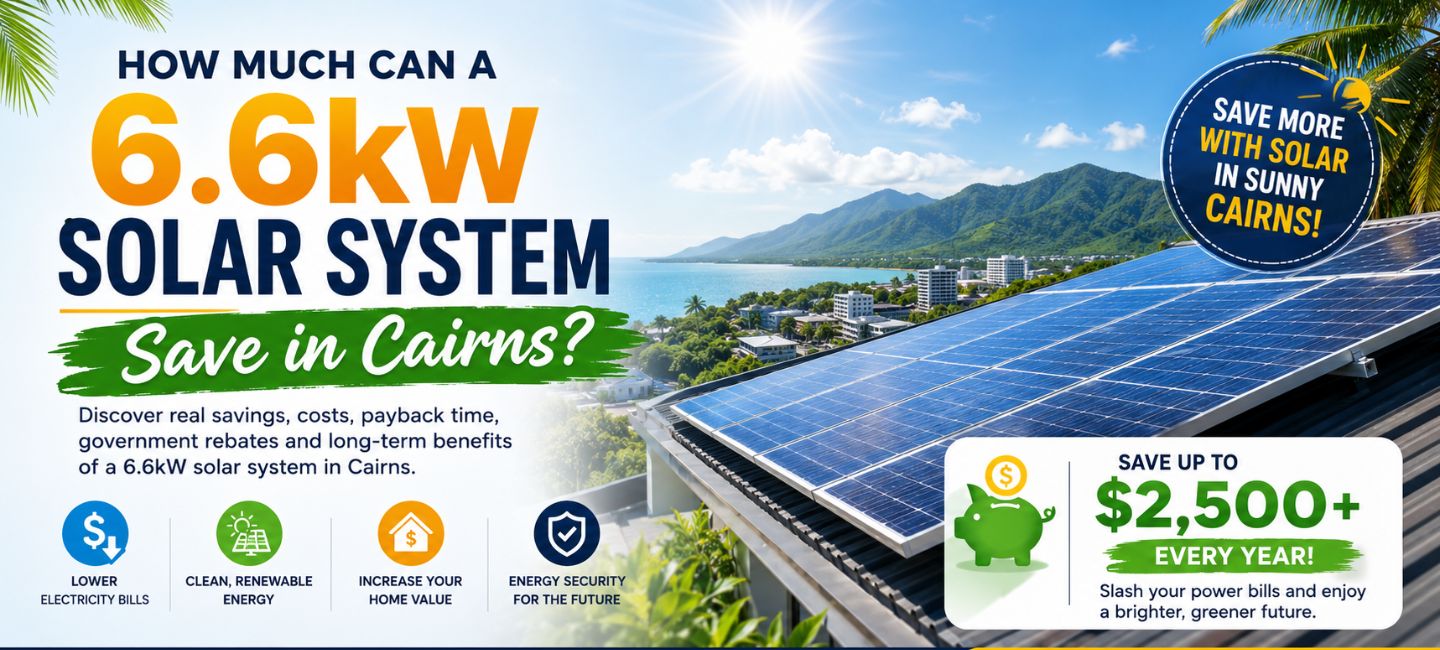
How Much Can a 6.6kW Solar System Save in Cairns? A Complete 2026 Guide
Electricity prices across Australia continue to rise, making homeowners search for smarter ways to reduce household expenses. If you live in Cairns or anywhere in North Queensland, you've probably wondered:
"How much money can a 6.6kW solar system actually save me?"
The answer is exciting.
Because Cairns enjoys some of Australia's highest sunshine hours, a properly installed 6.6kW solar system can dramatically reduce your electricity bills while increasing your property's value.
In this comprehensive guide, you'll discover:
- How much electricity a 6.6kW system produces
- Estimated yearly savings in Cairns
- How long it takes to pay for itself
- Government rebates available
- Factors affecting your savings
- Tips to maximize your return on investment
Whether you're a homeowner, first-time buyer, or simply exploring renewable energy, this guide will help you make an informed decision.
Why Cairns Is One of Australia's Best Cities for Solar Power
One of the biggest reasons homeowners in Cairns achieve excellent solar returns is simple:
Sunshine.
Cairns receives abundant sunshine throughout the year, allowing solar panels to generate impressive amounts of clean electricity even during winter months.
Benefits of Cairns' Climate
- High solar radiation
- Long daylight hours
- Strong annual energy production
- Faster return on investment
- Excellent conditions for rooftop solar
Unlike colder regions where cloudy weather affects production, North Queensland provides ideal conditions for residential solar systems.
What Is a 6.6kW Solar System?
A 6.6kW solar system is Australia's most popular residential solar size.
Typically, it includes:
- Around 15–16 high-efficiency solar panels (depending on panel wattage)
- A 5kW inverter
- Roof mounting system
- Safety equipment
- Grid connection
This size is ideal for:
- Families of 3–5 people
- Homes using air conditioning
- People working from home
- Households wanting lower electricity bills
It provides an excellent balance between affordability and energy production.
How Much Electricity Does a 6.6kW Solar System Generate in Cairns?
This is the question that matters most.
Thanks to Cairns' excellent climate, a quality 6.6kW system can generate approximately:
|
Time |
Estimated Energy Production |
||||
|
Daily |
24–30 kWh |
Monthly |
720–900 kWh |
Yearly |
8,700–10,900 kWh |
Actual production depends on:
- Roof direction
- Roof angle
- Shade
- Panel quality
- Weather
- Installation quality
Even under conservative estimates, production is impressive.
So, How Much Money Can You Save?
Now comes the exciting part.
Savings depend on:
- How much electricity you use
- When you use electricity
- Your electricity retailer
- Feed-in tariff
- Solar system efficiency
Typical Annual Savings
|
Household Type |
Estimated Annual Savings |
||||
|
Small Family |
$1,400–$1,900 |
Medium Family |
$1,800–$2,500 |
Large Family |
$2,300–$3,000+ |
Many households can reduce electricity bills by 60–90%.
If daytime electricity usage is high, savings become even greater because you're consuming your own solar power instead of buying electricity from the grid.
Example Savings Scenario
Let's look at a real-world example.
Family Profile
- Four-person family
- Air conditioner
- Washing machine
- Dishwasher
- Pool pump
- Work-from-home schedule
Without solar:
Annual electricity bill:≈ $3,200
With a 6.6kW system:
Annual bill:≈ $800
Annual savings:≈ $2,400
Over 25 years:
Potential savings exceed $50,000, depending on future electricity prices and system performance.
What Determines Your Solar Savings?
Every home is different.
Several factors influence how much you'll save.
1. Daytime Energy Usage
Solar panels generate electricity during daylight.
If you're home during the day, you'll use more free electricity.
Examples:
- Remote workers
- Stay-at-home parents
- Retirees
- Small home businesses
- These households often achieve the highest savings.
2. Roof Orientation
North-facing roofs generally receive the most sunlight.
However:
- East-facing roofs perform well.
- West-facing roofs also generate strong afternoon energy.
Modern panels perform efficiently across different roof orientations.
3. Shade
- Trees, chimneys, nearby buildings, and antennas can reduce production.
- Professional installers carefully assess shading before installation.
4. Panel Quality
Higher-quality panels generally offer:
- Better efficiency
- Longer lifespan
- Improved performance in heat
- Stronger warranties
Choosing quality equipment can significantly improve long-term savings.
5. Electricity Prices
Electricity prices have increased steadily over recent years.
As grid electricity becomes more expensive, solar savings often become even more valuable.
How Long Does It Take to Pay Off a 6.6kW Solar System?
One of the best things about solar is its excellent return on investment.
Many homeowners recover their installation cost in approximately:3–5 years
Considering quality systems often last 25 years or more, the remaining years provide substantial financial benefits. Think of it as making an investment that continues to generate value every sunny day.
Government Solar Rebates in Queensland
Australian homeowners may be eligible for government incentives that reduce the upfront cost of installing solar.
These incentives can make switching to solar more affordable.
Eligibility depends on:
- System size
- Installation by an accredited installer
- Approved solar products
Always discuss available rebates with your solar provider to understand current options.
Can Adding a Solar Battery Increase Savings?
Yes—but it depends on your lifestyle and energy usage.
A battery stores excess solar energy generated during the day for use at night.
Benefits of Solar Batteries
- Greater energy independence
- Reduced reliance on the grid
- Backup power (with compatible systems)
- Increased self-consumption of solar energy
While batteries require an additional investment, they can enhance long-term energy resilience for suitable households.
Why a 6.6kW System Is the Sweet Spot for Many Homes
Many homeowners choose a 6.6kW system because it offers a strong balance of cost, performance, and energy output.
Advantages
- Suitable for average family homes
- Excellent energy production
- Attractive return on investment
- Compatible with future battery upgrades
- Helps reduce carbon emissions
- Supports rising electricity demands
For many households in Cairns, it's a practical and future-ready choice.
Common Mistakes That Can Reduce Your Savings
Avoid these common pitfalls:
- Choosing the cheapest quote without comparing quality
- Ignoring roof shading issues
- Using low-quality equipment
- Hiring inexperienced installers
- Not considering future energy needs (such as electric vehicles or batteries)
- Failing to monitor system performance after installation
Working with a reputable solar installer can help you avoid these issues and maximize long-term value.
Quick Savings Checklist
Before installing solar, ask yourself:
- Do I use most of my electricity during the day?
- Is my roof in good condition?
- Does my roof receive plenty of sunlight?
- Am I planning to stay in my home for several years?
- Do I want protection from rising electricity prices?
If you answered "yes" to most of these, a 6.6kW solar system may be a strong fit.
Frequently Asked Questions (FAQs)
Is a 6.6kW solar system enough for a family home?
For many Australian households with average electricity usage, a 6.6kW system provides a good balance between energy production and affordability. Individual needs vary depending on consumption patterns.
Can a 6.6kW system eliminate my electricity bill?
Some households with high daytime energy use may significantly reduce their bills, but outcomes vary based on usage, weather, retailer tariffs, and system performance.
How long do solar panels last?
Most quality solar panels are designed to operate for 25 years or more, although their output gradually declines over time.
Does cloudy weather stop solar panels from working?
No. Solar panels continue to generate electricity on cloudy days, although production is generally lower than on clear, sunny days.
Is maintenance expensive?
Routine maintenance is usually limited to occasional cleaning (when required) and periodic inspections to ensure the system continues operating efficiently.
Final Thoughts
A 6.6kW solar system remains one of the most popular choices for homeowners in Cairns because it offers a compelling combination of energy production, long-term savings, and environmental benefits.
With Cairns' abundant sunshine, many households can substantially reduce their reliance on grid electricity while protecting themselves from future energy price increases. Although the exact amount you save depends on factors such as your electricity usage, roof characteristics, system quality, and tariff structure, a well-designed system can deliver significant value over its lifetime.
Investing in solar isn't just about lowering today's power bill—it's about creating a more energy-efficient home and making a long-term investment in clean, renewable energy.
Actionable Next Steps
Ready to explore whether a 6.6kW solar system is right for your home?
- Review your recent electricity bills to understand your current energy usage.
- Schedule a professional roof assessment to determine the best system layout.
- Compare quality solar equipment, warranties, and accredited installers—not just price.
- Ask about available Queensland and Australian government incentives.
- Consider whether a future battery upgrade or electric vehicle charging will affect your energy needs.
Want a personalised estimate? Request a free solar assessment and receive a tailored savings projection based on your home's roof, energy consumption, and location in Cairns.